Business
Wall Street Sinks as Nvidia Rout Drags the Nasdaq Into a Correction
Stocks fell sharply on Monday, with the Nasdaq dropping 2.5 percent and chip stocks plunging ahead of Nvidia's earnings report on Tuesday — the first since its founder resigned.
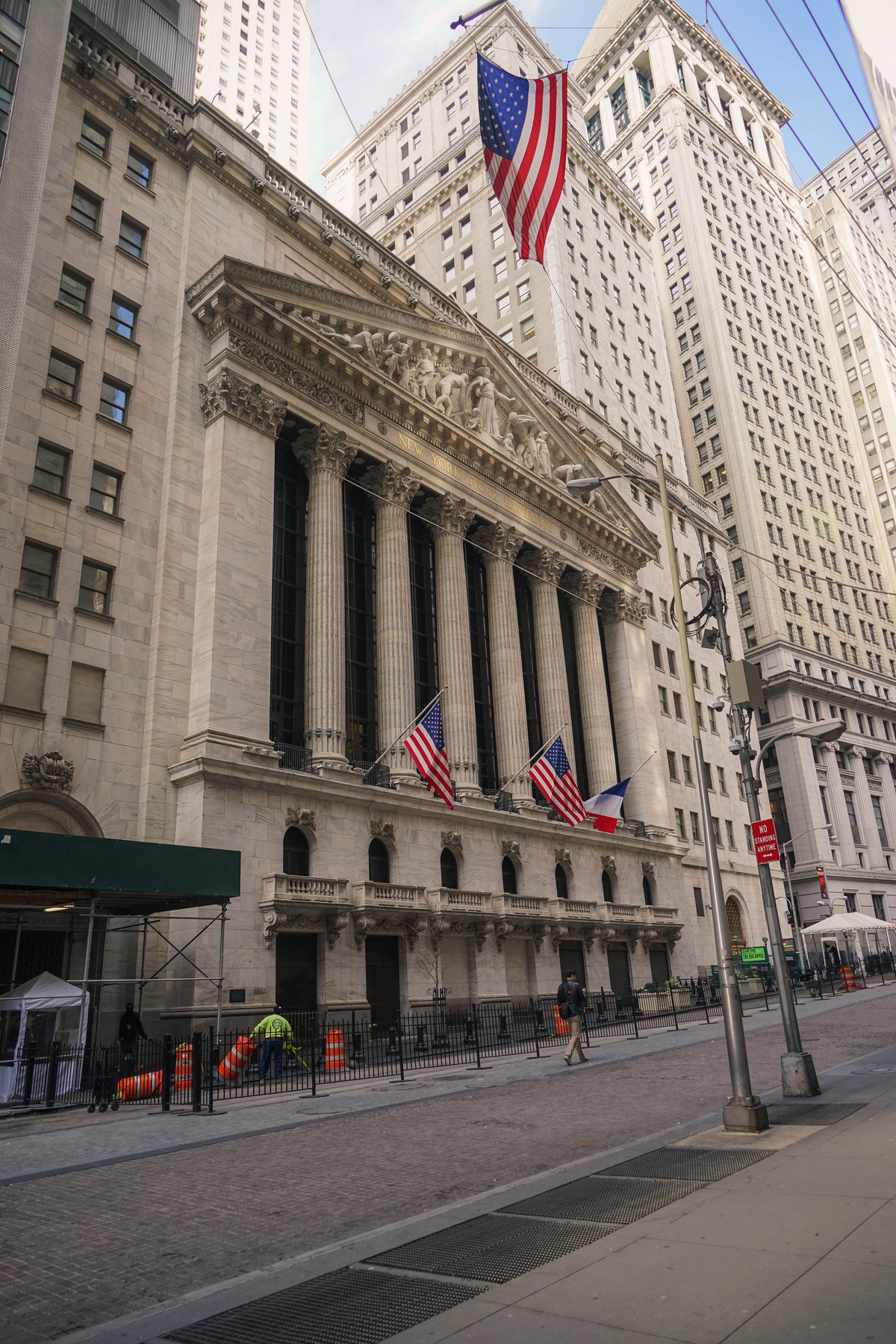
A broad selloff dragged U.S. stocks lower on Monday as fallout from Jensen Huang's resignation as Nvidia chief executive soured enthusiasm for artificial intelligence stocks, raising the stakes for the chipmaker's earnings report on Tuesday and Anthropic's initial public offering later in the week. The risk-off sentiment gathered momentum as the session progressed, with the S&P 500 dropping nearly 2 percent and the Dow falling more than 1.4 percent, while the Nasdaq suffered the steepest percentage loss.
The closing numbers told the story of a market turning on the trade that powered it for two years. The Dow Jones Industrial Average fell 739.38 points, or 1.41 percent, to 51,608.17, the S&P 500 lost 145.08 points, or 1.92 percent, to 7,416.59, and the Nasdaq Composite lost 626.51 points, or 2.49 percent, to 24,509.76. It was the third straight decline for the S&P 500 and the Nasdaq, and the Nasdaq is now more than 10 percent below its all-time closing high reached on October 6 — confirming that the index is in a correction.
Nvidia was at the center of the damage. The stock slid 4.1 percent to $156.14 on Monday, extending its losses after Huang's resignation following allegations of an affair with a suspected Chinese spy, and after plunging 13 percent last week. The shares are down 16 percent so far in 2026, a sharp reversal for the company that has been the face of the AI boom. Analysts expect Nvidia to post a 90.4 percent year-on-year earnings jump on revenue of $109.10 billion when it reports after Tuesday's closing bell, but investors are now focused as much on the company's guidance and its new interim chief executive, Colette Kress, as on the numbers themselves.
The selling spread across the whole chip complex. The Philadelphia Semiconductor Index lost 5.3 percent, with Intel and Micron both dropping more than 7 percent, Marvell and Arm each falling more than 7 percent, Advanced Micro Devices down 6 percent and Broadcom sliding 4 percent. Memory maker SanDisk and Nvidia-backed Lumentum each plunged more than 8 percent to pace the S&P 500's decliners, while server maker Dell dropped 7 percent and Super Micro Computer fell 6.9 percent. The iShares Semiconductor ETF was down 5 percent, and a memory-focused ETF declined 7 percent.
The rout was not limited to chipmakers. Hyperscalers Alphabet, Amazon and Meta slid between 2.4 percent and 4.1 percent, cloud provider CoreWeave dipped 6.1 percent and rival Nebius dropped 7.6 percent. 'It's the back-and-forth in this market of the AI-related stocks catching a bid versus this rotation trade,' said Ross Mayfield, investment strategy analyst at Baird in Louisville, Kentucky. 'Over the last couple of weeks, it's like a day-to-day thing where, you know, some days the AI names absolutely rip and then the very next day, you know, they're in a freefall.'
The breadth of the decline showed how few places there were to hide. Declining issues outnumbered advancers by a 3.45-to-1 ratio on the New York Stock Exchange, where there were 68 new highs and 590 new lows. On the Nasdaq, 1,131 stocks rose and 3,697 fell, a 3.27-to-1 ratio against advancers. The S&P 500 posted 21 new 52-week highs and seven new lows, while the Nasdaq recorded 51 new highs and 489 new lows. Volume on U.S. exchanges was 17.91 billion shares, compared with the 18.66 billion average for a full session over the last 20 trading days.
One corner of the market bucked the sell-off. Shares of Tyson Foods rose nearly 9 percent to lead S&P 500 advancers after the meat producer released its quarterly results, and General Mills and Hormel Foods each gained 3 percent, as the consumer staples index was one of only two S&P 500 sectors in the green on Monday. Utilities also inched higher. In other markets, bitcoin remained under pressure, trading at around $65,000, down from highs above $70,000 on Friday and near its lowest level since mid-August. Oil and gold fell with stocks: WTI crude futures, the U.S. benchmark, were down 3.4 percent at $85.55 per barrel, while gold futures fell 0.8 percent to $3,855 an ounce, their lowest level since October 2025.
The bond market added to the pressure. The yield on the 10-year Treasury was at 5.13 percent on Monday, down slightly from 5.15 percent at Friday's close, but it soared last week following economic data that reinforced market expectations the Federal Reserve will raise interest rates again in December. Federal Reserve Chair Kevin Warsh said on Monday that new technologies will have a significant impact on the economy, but that the possible scenarios range from rising growth with broadly shared gains to higher unemployment and a potential slowdown if anticipated investment returns prove disappointing. Minutes from the Federal Open Market Committee's latest meeting, due for release on Wednesday, could offer clues on the policy outlook ahead of next month's interest-rate decision, and markets are pricing in a near-certain 95.7 percent likelihood of a 25-basis-point rate hike in December, according to CME FedWatch.
The scale of the reversal is striking. In mid-June the semiconductor index was up 106.6 percent year-to-date, but that luster has faded in recent months, reducing its 2026 gain to around 43 percent — still about four times the gains of the broader S&P 500 so far this year. Year to date, the S&P 500 has added 8 percent and the Nasdaq Composite 5 percent. Whether Monday was a buying opportunity or the start of something worse now turns on two events this week: Nvidia's results after Tuesday's close, and Anthropic's market debut on Thursday.
Why it matters: Monday's sell-off was not a random bad day — it was the AI trade unwinding in public, with the Nasdaq confirming a correction and chip stocks falling twice as fast as the broader market. The trigger was Nvidia's leadership crisis, but the deeper worry is whether the trillions being poured into AI infrastructure will ever earn their keep, a question Nvidia's own earnings and Anthropic's debut will now have to answer in the same week. With a likely Fed rate hike also looming in December, the market has lost both of its safety nets at once: cheap money and unquestioned faith in AI.
Reporting: SRN News · Investopedia
Spot an error? Orbit News corrects articles promptly and notes the correction in the article. See our Editorial Policy, or flag an error by messaging us on Facebook, X, or Instagram.