Business
Nvidia's Vera Rubin Sweeps AI Benchmarks as Partners Ramp Up Shipments
Nvidia's new Vera Rubin platform posted the fastest time on six of seven MLPerf Training benchmarks in its debut, doubling its predecessor's speed on the hardest workload — even as the company's stock reels ahead of Tuesday's earnings report.
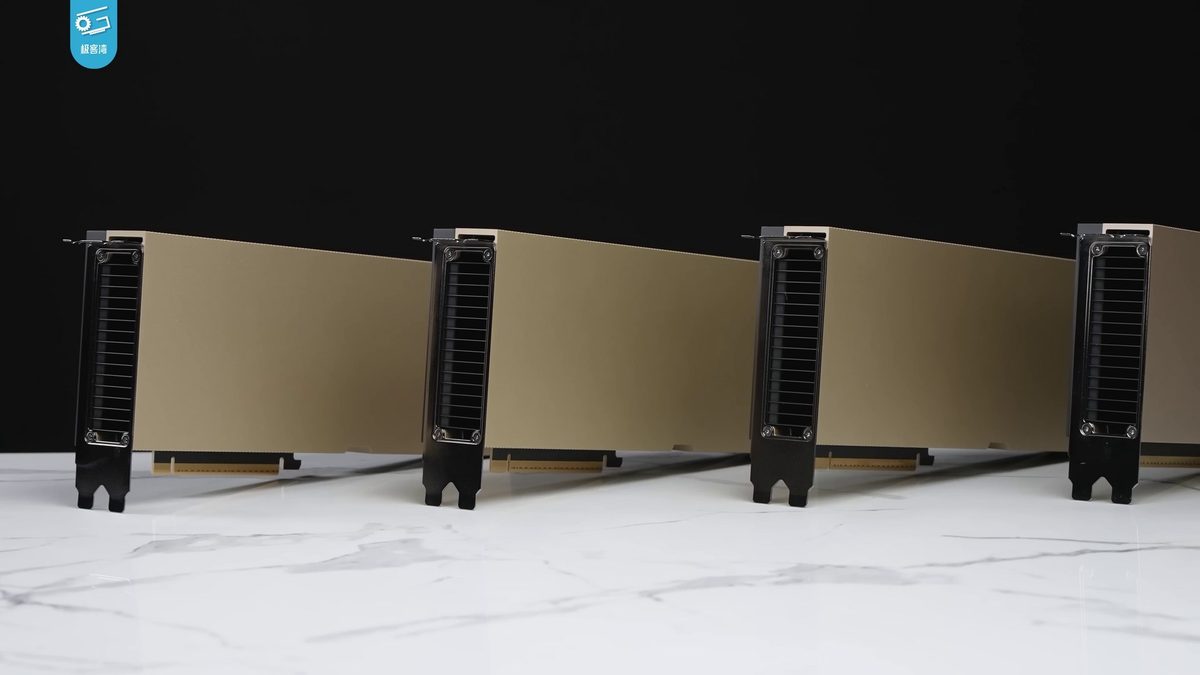
Nvidia's next-generation Vera Rubin platform has made its debut at the top of the industry's most watched AI benchmark suite, delivering the fastest time to train on six of the seven benchmarks in MLPerf Training v6.1 and up to twice the per-GPU performance of the company's own GB300 system. The results, published this week, arrive on the same day the company reports quarterly earnings after the market closes — its first results since founder Jensen Huang resigned.
MLPerf Training v6.1 marks the debut of the Vera Rubin architecture, and the early results show a software stack that is already mature. In its first appearance, the Vera Rubin NVL72 platform delivered the fastest time to train on six of the seven benchmarks, achieving up to twice the performance of a highly optimized Nvidia GB300 NVL72 baseline. For the seventh benchmark, DeepSeek-V3, Nvidia captured the absolute fastest time of the round with a massive GB300 cluster. Together, Nvidia platforms hold the fastest time to train on every benchmark in the round, and Nvidia's platforms were the only ones to submit results across all seven benchmarks.
The largest gain landed on the largest, most communication-heavy model. DeepSeek-V3 is a 671-billion-parameter mixture-of-experts model and the most demanding workload in the suite, where expert parallelism turns every iteration into a burst of all-to-all communication. Vera Rubin NVL72 trained the benchmark in 4.14 minutes using 1,024 GPUs across 16 racks, while GB300 NVL72 ran the identical 1,024-GPU configuration in 8.03 minutes — close to twice the speed per GPU. Halving time to train roughly doubles how many experiments a team can run in a quarter, and experiment throughput is what moves model quality.
The gains held across the rest of the suite. Vera Rubin was 1.4 times faster than GB300 on the new Qwen3.5 reinforcement-learning benchmark and on the DLRMv4 recommendation benchmark, 1.5 times faster on Llama 2 70B and the FLUX.1 image-generation model, and 1.6 times faster on the gpt-oss 20B and Llama 3.1 8B models. The suite covers natural language, image generation, recommendation and reinforcement learning, so the gains hold across multiple modalities as well as different model shapes and architectures.
The new reinforcement-learning benchmark matters most for where AI development is heading. MLPerf Training v6.1 adds its first agentic LLM reinforcement learning post-training benchmark, Qwen 3.5 397B GRPO, reflecting a shift in which post-training has become the critical differentiator for agentic accuracy. Vera Rubin achieved the fastest time for the new benchmark at 10.44 minutes with 1,024 GPUs, compared with 13.78 minutes for GB300 at the same scale — and it did so on two different inference backends, Nvidia NeMo RL with TensorRT-LLM and vLLM, which the company says speaks as much about software maturity as it does about silicon.
The Vera CPU, Nvidia's first in-house data-center processor, is integral to that result. Teaching AI agents to observe, reason and act requires running each rollout in a simulated environment and executing tool calls, code or API validations — work that is intensely CPU-bound. The Vera CPU sustains more than 22,500 concurrent reinforcement-learning environments across 256 CPUs in a single Vera CPU rack, keeping the GPUs fed with the feedback needed to perfect agentic workflows.
Inside the rack, Vera Rubin NVL72 connects 72 GPUs and 36 CPUs through a copper NVLink 6 spine, delivering 3.6 terabytes per second per GPU and 260 terabytes per second per rack. Beyond the rack, the platform scales out via ConnectX-9 SuperNICs over Quantum-X800 InfiniBand or Spectrum-X Ethernet. On the DeepSeek-V3 benchmark, Vera Rubin achieved above 97 percent scaling efficiency as it grew from 256 to 1,024 GPUs. At a larger scale, GB300 produced the fastest absolute result of the round: 1.38 minutes across 10,240 GPUs, one training job spread across 160 racks.
The hardware is already moving into customers' hands. ASUS announced on Tuesday, November 17, that it is ramping up volume shipments of Nvidia Vera Rubin NVL72 systems in the fourth quarter to meet robust market demand, and is showcasing its AI Factory reference architecture at the SC26 supercomputing conference in Chicago. At the center of the showcase is the ASUS AI POD XA VR721-E3, which integrates 72 Nvidia Rubin GPUs and 36 Nvidia Vera CPUs in a fully liquid-cooled, rack-scale architecture designed for frontier-model training, complex reasoning and high-throughput inference.
The benchmark sweep lands at a delicate moment for Nvidia. The stock closed Monday at $156.14, down 4.12 percent, and has lost about $2 trillion in market value in six weeks as investors weigh the leadership change, export controls and doubts about AI spending. Tuesday's earnings report — the first led by interim chief executive Colette Kress — will show whether the demand for the new hardware is as strong as the benchmarks suggest. Nvidia also re-ran several benchmarks with a newer software build and reported further gains, including up to 2.4 times faster training on one workload, but those results are unverified and have not been through MLPerf review, so they should be read as the company's own claim rather than an independent result.
Why it matters: The Vera Rubin results are the strongest evidence yet that Nvidia's technology roadmap survived its leadership crisis intact — the new platform is faster across every type of AI workload, not just one, and partners are already shipping it at volume. But benchmarks do not pay for data centers, and the market's question is whether customers will keep buying at the same pace now that Huang is gone and export controls are biting. That is why Tuesday's earnings call matters more than the benchmark tables: Kress must show that the order book behind Vera Rubin is as strong as its test scores.
Reporting: Nvidia · TradingView
Spot an error? Orbit News corrects articles promptly and notes the correction in the article. See our Editorial Policy, or flag an error by messaging us on Facebook, X, or Instagram.