U.S. News
An 8-Year-Old Went to an ICE Check-In With His Uncle. He Left in Federal Custody.
The Haitian third-grader was separated from the uncle who had raised him since his father's deportation, and his school district says it still does not know where he is being held.
An 8-year-old Haitian boy who went to a scheduled immigration check-in in downtown San Diego this week was taken into federal custody and separated from the uncle who had been raising him. His school district says the check-in was on Wednesday, November 4; the Department of Homeland Security and a congressional letter say it was November 5. A letter had summoned the child to meet with immigration officers, and his uncle brought him to the Edward J. Schwartz federal building as instructed. He left without him. Video recorded by Karen Pohl, a volunteer court observer with the group Detention Resistance, shows officers from ICE's Enforcement and Removal Operations leading the boy away.
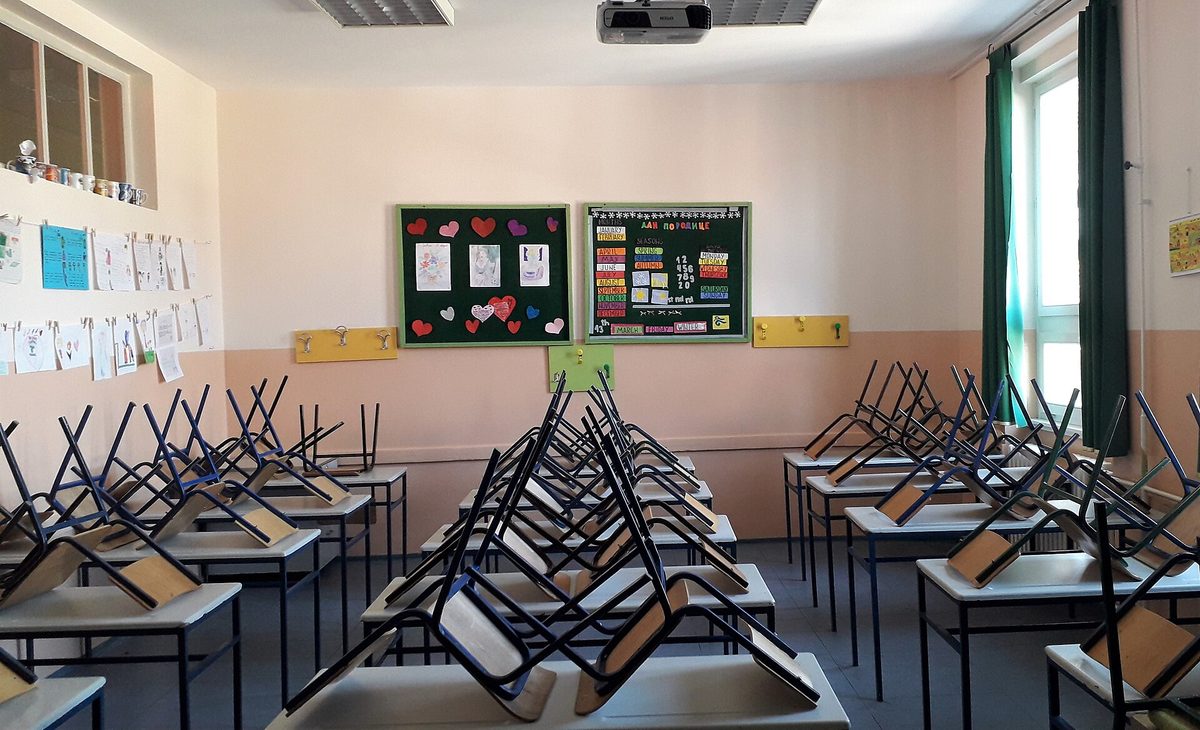
The boy, a third grader at Fay Elementary School in the City Heights neighborhood, has not been publicly identified. He had been living with his uncle since his father was deported in March 2025, and school records listed the uncle as an authorized caregiver. Two days after the check-in, his school district said it still could not find out where he was being held. His classmates have been so frightened for him that the district has sent crisis counselors to their school, and his seat at Fay Elementary sits empty while his school, his family and city leaders wait for an answer.
The Department of Homeland Security says the uncle could not prove he was the boy's legal guardian. A spokesperson told NBC 7 that ICE confirmed the man was not part of either family unit the child had lived with. Because of that, the department says, the boy counts as an unaccompanied minor under the Trafficking Victims Protection Reauthorization Act, a 2008 anti-trafficking law. ICE placed him with the Office of Refugee Resettlement, the agency within Health and Human Services that cares for migrant children who arrive without a parent or guardian.
"Out of an abundance of caution and to ensure the child's safety, ICE determined it was best to remove the child from the household and place him in the care of the Office of Refugee Resettlement," the department said in a statement. The department added that the boy's father had been deported to Mexico by U.S. Customs and Border Protection. It also disputed descriptions of the child's placement as detention, calling those claims false. Federal officials have not said publicly where the child is being held, and the Office of Refugee Resettlement has declined to discuss individual cases, citing privacy protections for children in its care.
The case has now drawn in Congress. On Tuesday, November 10, California lawmakers led by U.S. Representatives Juan Vargas, Sara Jacobs, Scott Peters and Mike Levin, alongside U.S. Senators Alex Padilla and Adam Schiff, sent a joint inquiry to the Department of Homeland Security and the Department of Health and Human Services, demanding immediate clarification of the child's whereabouts, justification for the use of restraints on a minor, and an emergency reunification plan. The lawmakers wrote that "video footage appears to show the use of restraints on a child who seemed to pose no threat to those around him, raising serious questions about the handling of this incident." They asked the agencies for an update on their findings by December 1.
The lawmakers noted they had pressed the administration before about immigration enforcement around schools, pointing to a September letter on enforcement activity near school and educational institutions. In their new letter, they asked the agencies to confirm the child's whereabouts, whether his family knows where he is, and what steps are being taken to reunite him with them. "Every child deserves stability, dignity, and access to education," the district officials wrote in their own November 6 letter to the secretaries of Homeland Security and Health and Human Services.
The boy had previously held Temporary Protected Status, a humanitarian designation that for more than a decade shielded hundreds of thousands of Haitians from deportation and allowed them to live and work in the United States. The protection was first granted after the earthquake that devastated Haiti in 2010. On June 25, 2026, the Supreme Court ruled 6-3 in Mullin v. Doe that the administration could end the program, and the Department of Homeland Security set the termination date as July 27, affecting hundreds of thousands of Haitian and Syrian holders. Its loss has reverberated through Haitian communities across the country, including in Miami's Little Haiti and in Springfield, Ohio, home to as many as 15,000 Haitians.
For now, the boy's family is working to resolve the custody question. His uncle can apply to the Office of Refugee Resettlement to become his sponsor, but with children now waiting an average of 185 days in federal shelters, that could take months. The district's letter put the stakes in plain terms: "While immigration policy decisions are often framed as matters of law and enforcement, their real-world consequences are increasingly being experienced by children whose lives, education and emotional well-being are disrupted through no fault of their own."
The boy is one of thousands of children swept into the federal shelter system in the current enforcement push. More than 8,000 children were arrested and detained by immigration authorities between January 2025 and July 2026, according to data from the Deportation Data Project, and as of November 5, 1,620 children were in the custody of the Department of Health and Human Services as unaccompanied minors. For children in that system, the wait to go home has grown far longer: the average stay in federal shelters rose from 35 days in October 2024 to 185 days in November 2025. The boy's family, his school and city leaders are waiting for word on where he is and when he can come home.
Why it matters: This case shows what the current enforcement drive looks like at its sharpest edge: a child who followed the rules, showed up for an appointment with the only caregiver he has, and was taken into federal custody under a trafficking law written to protect children from exploitation. The dispute now turns on a single legal question with enormous human consequences — whether an uncle who raised a child, is listed on school records and complied with a summons counts as a guardian — and on how long a third-grader can be held while adults argue about it.
Reporting: USA Today · U.S. House of Representatives
Spot an error? Orbit News corrects articles promptly and notes the correction in the article. See our Editorial Policy, or flag an error by messaging us on Facebook, X, or Instagram.
Related from Orbit News

FAA Lifts Nationwide Ground Stop After Communications Outage Strands Thousands
U.S. News · Nov 14, 2026
Supreme Court Agrees to Decide Whether Trump Can Bar Asylum at the Southern Border
U.S. News · Nov 14, 2026