U.S. News
Voyager 1 Reaches One Light-Day From Earth, a First for Any Human-Made Object
NASA says the probe crossed the milestone at 5:16 a.m. ET on Wednesday, nearly 50 years after launch, and a radio signal now takes a full day to reach it.
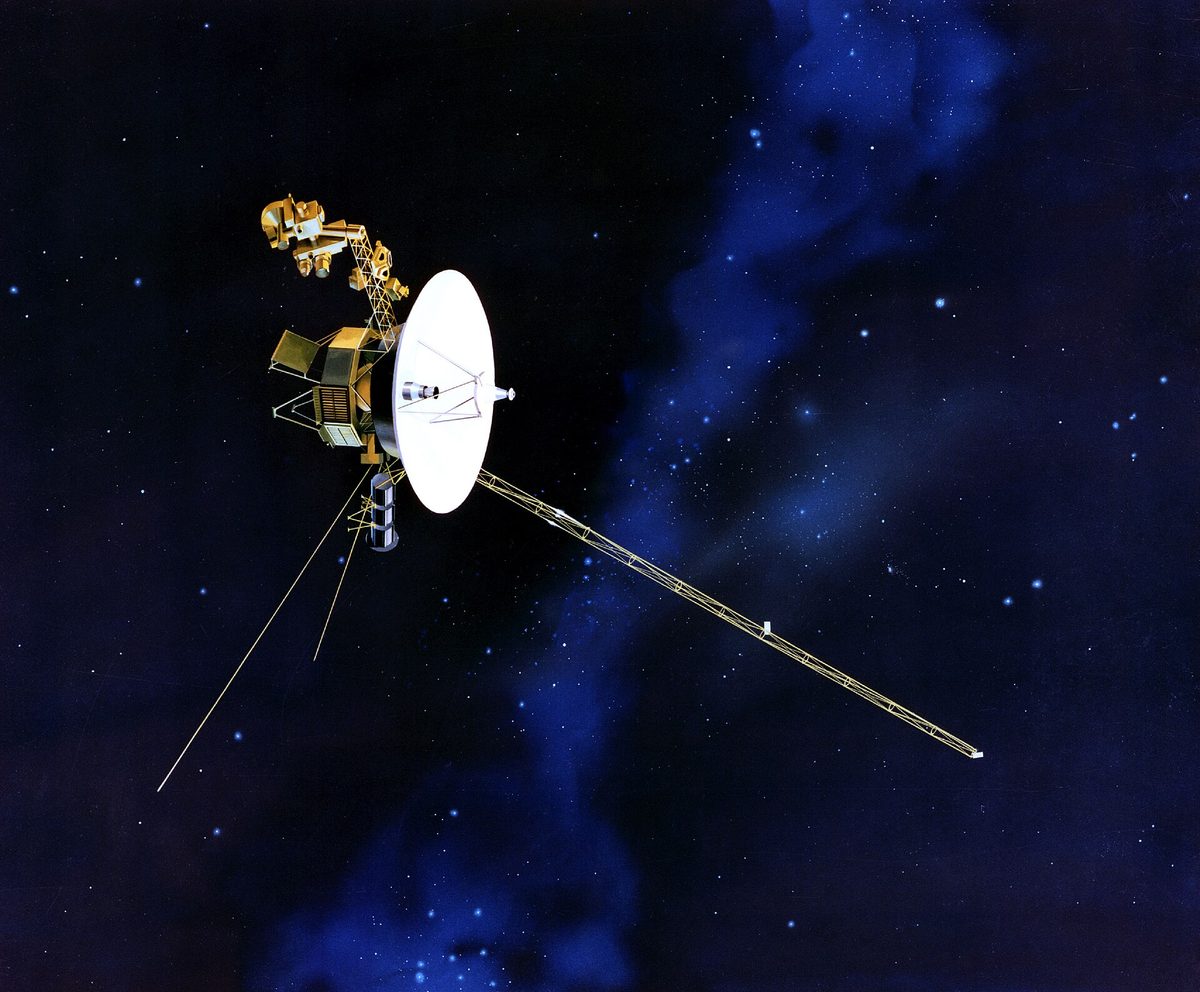
NASA's Voyager 1 spacecraft has gone where no human-made object has ever been: one light-day from Earth. The probe reached the milestone on Wednesday, Nov. 18, at 5:16 a.m. ET, according to NASA, putting it more than 16 billion miles from home after nearly half a century in flight.
A light-day is the distance a particle of light can travel in 24 hours, equal to about 16 billion miles, or about 26 billion kilometers. For Voyager 1, that distance now defines how far it has travelled from Earth, and how long it takes to talk to it: a radio signal sent from Earth takes a full 24 hours to reach the spacecraft, so a command sent on Wednesday would not arrive until Thursday, and any reply would take another day to come back.
The milestone is a matter of distance, not a physical boundary. NASA says the spacecraft will experience no environmental change as it crosses the threshold, and nothing on board will change when it passes the mark. Its significance is the record itself: for the first time, something built by humans has travelled a full light-day from Earth.
Voyager 1 launched in 1977 from Cape Canaveral, Florida, on a mission to explore the outer reaches of the solar system, and it has been travelling ever since. It flew past Jupiter in 1979 and Saturn in 1980, then kept going, leaving the planets behind. In 1998 it passed Pioneer 10 to become the most distant human-made object from Earth, a record it has held ever since, according to NASA.
The probe crossed into interstellar space in 2012, leaving the heliosphere, the vast bubble of charged particles and magnetic fields created by the Sun. Voyager 1 and its twin, Voyager 2, are the only spacecraft ever to venture beyond that bubble. Voyager 2 is expected to reach the one light-day milestone about nine years later, in November 2035.
The journey has been slow by cosmic standards. Voyager 1 is cruising at nearly 38,000 mph, or 61,000 kph, through the vacuum of space, yet NASA says it took the spacecraft 49 years, two months, and 11 days to travel a distance that light itself covers in a single day. That gap between the speed of light and the speed of the fastest thing humans have ever sent into deep space is the point of the milestone.
Both Voyager spacecraft are powered by radioisotope thermoelectric generators, which produce electricity from the heat released by decaying plutonium. As that fuel supply slowly declines, each probe loses about 4 watts of power every year, according to NASA, and after nearly 50 years their available power has become increasingly limited, forcing mission engineers to conserve energy by shutting down nonessential systems.
Voyager 1 is headed in the direction of a star more than 17 light-years away from Earth called Gliese 445, an obscure star in the constellation Ursa Minor, also known as the Little Dipper. NASA says the spacecraft is expected to pass within about 1.7 light-years of that star in 40,000 years, a reminder that even at its record distance, the probe has barely begun its journey between the stars.
NASA marked the occasion by inviting the public to take part in what it calls Shine Bright for Voyager's Light-Day, asking people around the world to flash a message to the spacecraft with phones, flashlights, and even entire buildings after sunset on Tuesday, Nov. 17. The agency described the moment as a day worth celebrating, the culmination of a mission that was designed to last a few years and has instead run for nearly five decades.
Why it matters: Voyager 1 is the longest-running mission in spaceflight history, and the one-light-day mark is the clearest measure yet of how far a human-built object has travelled. The milestone matters because it is also a communications boundary: from here on, every instruction takes a day to arrive and every answer takes a day to return, so the spacecraft is effectively operating on its own. As its power fades and engineers switch off systems one by one, each new record is also a reminder that the mission is finite, and that the data it sends back from interstellar space cannot be gathered any other way.
Spot an error? Orbit News corrects articles promptly and notes the correction in the article. See our Editorial Policy, or flag an error by messaging us on Facebook, X, or Instagram.
Related from Orbit News

Huawei Trial Nears Its End as Jury Prepares to Deliberate in Brooklyn
U.S. News · Nov 18, 2026
Judge Blocks Trump Administration's Limits on Internships for International Students
U.S. News · Nov 18, 2026