Politics
Trump, Xi and Putin to Hold First-Ever Three-Way Meeting in China Next Week
The White House says the three leaders will meet Thursday on the sidelines of the APEC summit in Shenzhen to discuss nuclear arms reductions and the war with Iran, though officials expect no agreement.
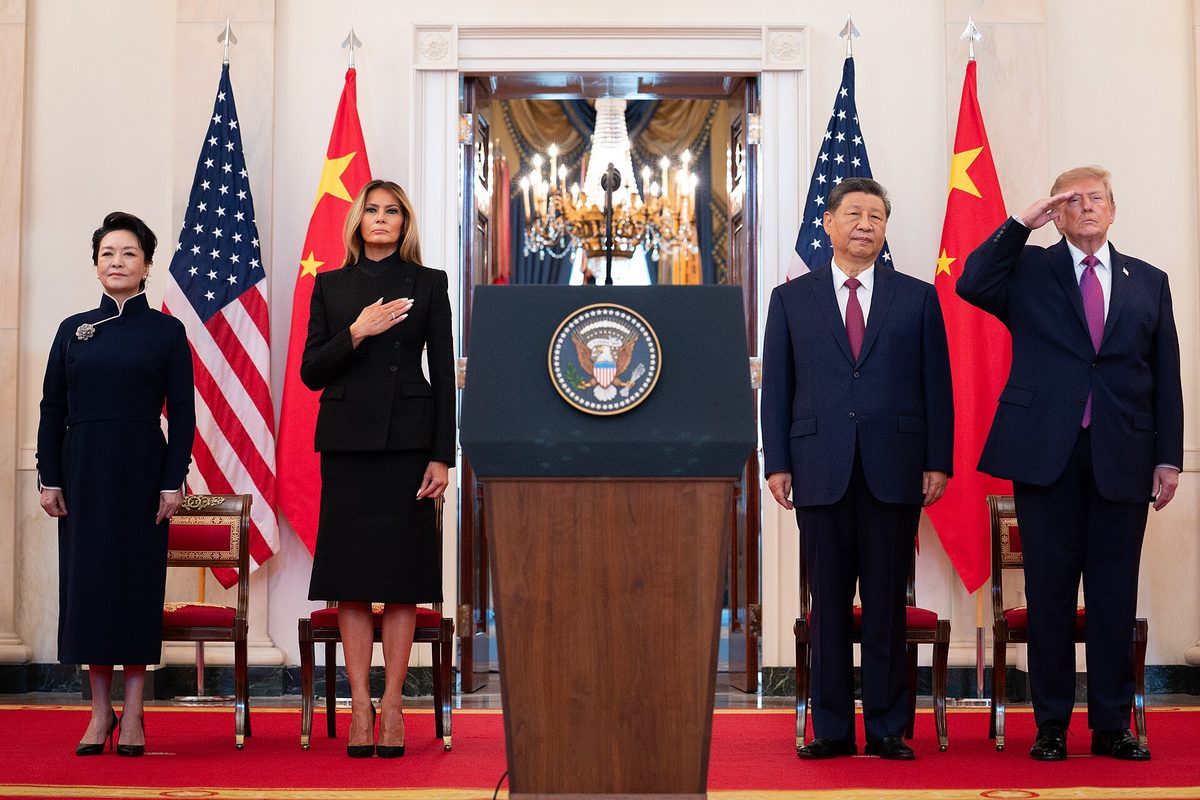
The leaders of the United States, China and Russia plan to meet Thursday on the sidelines of next week's Asia-Pacific Economic Cooperation summit in China's tech hub of Shenzhen, in an unprecedented gathering of the heads of the world's biggest nuclear powers. The White House confirmed the plans on Friday, setting up the first-ever trilateral sit-down between President Donald Trump, Chinese President Xi Jinping and Russian President Vladimir Putin. The meeting will take place on the sidelines of the APEC summit in Shenzhen, according to the White House, and will focus on nuclear non-proliferation, a subject Trump has said could yield a new agreement between the world's biggest nuclear-armed states.
Trump has insisted the meeting is a chance for the three countries to reach a deal on their nuclear stockpiles, but officials on his own team have moved quickly to lower expectations. "We do not expect to get to any kind of agreement," a senior U.S. official told reporters, describing the session as the entry point for a first conversation at leader level between the three countries. "So this is the beginning of hopefully a conversation that can be productive going forward," the official added. The White House spokesman, Olivia Wales, said Trump would press the case for reducing nuclear arsenals, warning that the proliferation of nuclear weapons poses serious dangers.
The stakes are high because the last nuclear arms treaty between the United States and Russia expired in February, leaving the world's two largest atomic arsenals without caps for the first time in more than half a century. When that treaty, known as New START, expired, Trump rejected a call by Russia to extend the two-country deal for another year and called instead for "a new, improved and modernized" agreement that includes China. Beijing's arsenal of more than 600 warheads, according to Pentagon estimates, is far smaller than the inventories held by the United States and Russia, each estimated at more than 5,000 warheads, and China has shown little interest in a pact that would freeze it at a disadvantage.
The three leaders are also expected to discuss the U.S. war with Iran, according to the White House, but Trump plans to steer away from discussing Ukraine, the senior U.S. official said. That omission has alarmed Kyiv. Ukrainian President Volodymyr Zelensky voiced concern last month that a trilateral meeting between Trump, Xi and Putin might lead to dealmaking about the future of Ukraine without consulting his government. "We really don't want this to turn into 'Yalta 2, 3, 4,' with a redistribution of influence," Zelensky told journalists, drawing a comparison with the 1945 Yalta Conference at which the Allied powers effectively redrew the global map after the Second World War.
The Kremlin says the meeting will take place on November 19 in Shenzhen, but there has been no confirmation yet from China, according to CNN. Trump will travel to Shenzhen for the APEC summit. Elon Musk is expected to travel with Trump on the trip but will not attend the trilateral meeting, the senior U.S. official said. The APEC summit brings together 21 economies and marks a major moment for China to show off Shenzhen, the fast-growing coastal metropolis that transformed from a small fishing village into a global technology hub in just a few decades.
While a trilateral meeting in this exact formation is unprecedented, the three leaders have a wealth of history in pairs. Xi and Putin have met more than 40 times since Xi became president in 2013, addressing each other as "dear friend" and the two countries declared a "no-limits friendship" shortly before Russia sent troops into Ukraine in 2022. Trump and Putin have met face-to-face on seven occasions, most recently in Alaska in August 2025, while Xi and Trump have held face-to-face talks on eight occasions, including a state visit to Washington by Xi in September. Trump has warmly embraced Xi since the two sides reached a truce in their short-lived trade war last year.
Analysts say expectations are low that the talks will lead to major breakthroughs and that the meeting will be heavier in symbolism than substance. Beijing was the least certain of the three capitals about the value of the summit, and by agreeing to host it Xi may be calculating that the moment offers him a chance to flex China's growing clout and prestige. For the Kremlin, the planned meeting is a coveted chance to posture as a superpower on par with Washington and Beijing. "I think the key for Putin was that this was very much about signaling a desire to talk to the president and talk to Chairman Xi in a way that suggests that they're making decisions on Ukraine, which obviously the Ukrainians and the Europeans don't like," said Edgard Kagan, a former U.S. ambassador to Malaysia now at the Center for Strategic and International Studies.
The gathering could also complicate China's own agenda at APEC, where Beijing has sought to portray itself as a defender of free trade. "You sort of run counter to Chinese support of multilateralism," said Hoo Tiang Boon, a professor of Chinese foreign policy at Nanyang Technological University. Trump, meanwhile, has faced domestic criticism for suspending fuel export sanctions on Russia for at least six months in October, allowing Putin to release diesel into the global energy market, a move a bipartisan group of lawmakers accused him of making in defiance of a federal law designed to crack down on Russia. The trilateral could very well overshadow the APEC summit itself, and what the three leaders say afterward, rather than any document they sign, is likely to set the tone for the next phase of great-power diplomacy.
For now, the most concrete things to watch are whether Beijing publicly confirms the meeting, what the three leaders say about nuclear arsenals and Iran when they emerge, and whether the encounter produces a follow-on process or simply a photograph. The White House has framed the session as the start of a conversation, not its conclusion, and with no agreement expected, the test will be whether the three most powerful leaders in the world can agree even on what to talk about next.
Why it matters: This is the first time the leaders of the three largest nuclear powers have ever sat down together, and it comes at a moment when the guardrails that capped their arsenals have fallen away. With New START expired since February and no treaty limiting the two biggest stockpiles, even a conversation without an agreement matters, because it establishes whether a three-way arms framework is possible at all. The symbolism cuts both ways: for Trump it is a stage to claim peacemaker status, for Putin a return to the top table as an equal, and for Xi a showcase of Chinese prestige, while Ukraine watches warily for any hint of a deal struck over its head. What matters next is not the handshake but whether Beijing confirms the meeting and whether the leaders leave Shenzhen with a date for a second conversation.
Reporting: CNN · Military.com
Spot an error? Orbit News corrects articles promptly and notes the correction in the article. See our Editorial Policy, or flag an error by messaging us on Facebook, X, or Instagram.