U.S. News
SS United States Sinks Off Florida to Become the World's Largest Artificial Reef
The 990-foot ocean liner, once the fastest passenger ship in the world, was sunk off the Florida coast on Wednesday to become the largest artificial reef on the planet.
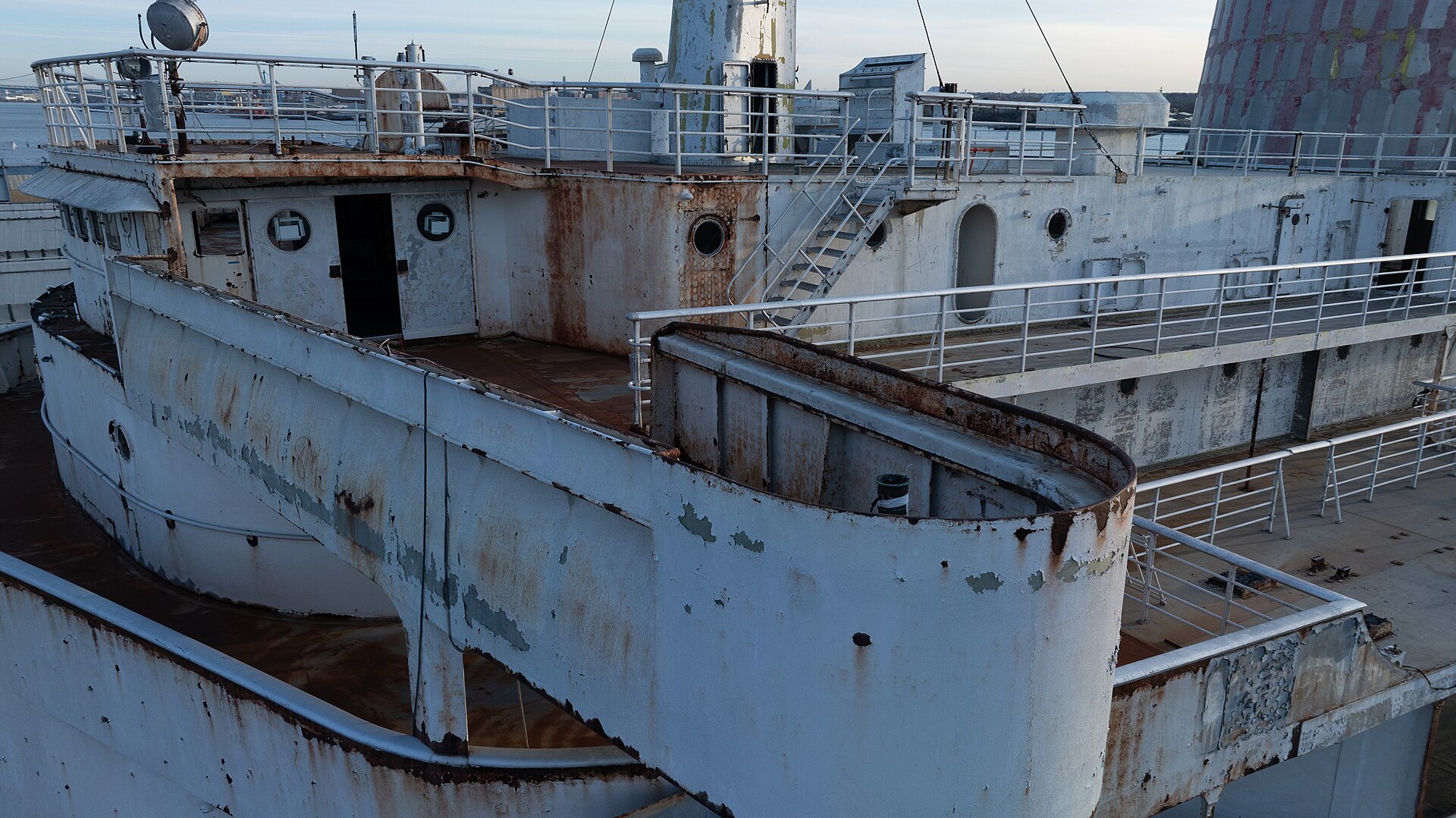
The SS United States, the fastest ocean liner ever built, slipped beneath the Gulf of Mexico on Wednesday night, November 11, ending 75 years above the water and beginning a new life as the world's largest artificial reef. The 990-foot ship settled onto the seafloor off Okaloosa County, Florida, at 9:59 p.m. Eastern time, seven hours and 19 minutes after crews began flooding it at about 2:40 p.m. The vessel now sits in 180 to 200 feet of water, with its upper decks 55 to 60 feet below the surface.
Crews sank the ship without explosives, removing plugs in the hull and letting seawater in until the liner tilted onto its side and dipped below the waves. It was placed just over 20 nautical miles from the beaches of Destin, in a spot chosen so that its upper decks stay within reach of recreational divers while the hull below is a job for technical divers.
The sinking makes the SS United States the largest artificial reef in the world, taking the title from the USS Oriskany, an 888-foot aircraft carrier the U.S. Navy sank off Pensacola in 2006. The two wrecks will sit about 13 nautical miles apart, giving the Florida Panhandle the first and second largest artificial reefs on the planet. Florida has created more than 4,000 artificial reefs since 1940, according to the state fish and wildlife commission.
The ship was launched in 1951 and crossed the Atlantic in less than four days, making it the fastest passenger liner in the world. Longer than the RMS Titanic, it carried four presidents, the Mona Lisa and a generation of movie stars in its postwar prime, before the age of the passenger jet ended the era of the great liners. It then spent decades rusting at a dock in Philadelphia, facing the scrap heap, until its minders settled on sinking it as a reef.
The SS United States Conservancy, which looked after the ship through its long stretch moored in Philadelphia, sold it to Okaloosa County for $1 million in 2024. Susan Gibbs, the head of the conservancy and the granddaughter of the ship's designer, William Francis Gibbs, said she felt 'a complex mix of sorrow but gratitude and pride and hope' as the sinking approached. 'We felt that reefing was by far the more dignified solution,' she said.
Okaloosa County sees the wreck as a tourism draw. Its reefs already bring in roughly $10 million to $12 million in annual economic benefits, tourism director Jennifer Adams said, and she expects that number to climb. The county hopes to recoup its $10 million investment in the project in 'a couple of years.' Adams said plans are already in the works to sink 'five or six' additional artificial reefs after the SS United States. 'Certainly this is the biggest that we've done,' she said.
Divers are expected to start descending in large numbers. 'We anticipate the SS United States is going to be super popular,' said Savanna Christy, owner and instructor at ScubaTech, a dive center in Destin. 'Those who are eager to dive immediately are there for the historical factor,' she said. 'There's something really cool about a wreck when it's first gone down, before it attracts any marine growth.' There were about 2.5 million active scuba divers in the United States in 2024, according to DEMA, a dive marketing organization.
The wreck will be open to divers of different abilities. The top decks, 55 to 60 feet down, are within reach of a diver with basic Open Water certification, while the deeper hull and interior spaces, including the engine room and the pool, are for technical and cave divers with advanced training. Dive operators are also planning trips aimed at the 40- to 50-foot range to bring newer divers in. 'Marine life will quickly start to gravitate to the wreck and start living there,' Christy said. 'You'll see sharks and turtles and small reef fish.' Snappers, groupers and amberjack are among the fish expected to move in.
The sinking was a bittersweet moment for the wreck-diving community. 'For those of us who love shipwrecks and love ships in general, it was way more tragic to see it sitting and rusting away at the dock,' said Karen Flynn, a wreck diver whose Maryland-based club booked a charter boat days after the sinking date was set. 'There's something about looking out over that bridge... and seeing the nose of the bow and then seeing just the blue out in front of it,' she said. 'That is going to be a spectacular shot.' The code for diving the wreck is simple, Christy said: 'Take only photos, leave only bubbles.' Florida law backs that up, with fines and jail time for anyone who removes objects from a wreck.
Why it matters: The sinking of the SS United States closes the book on the golden age of the ocean liner and opens a very modern chapter: a piece of American maritime history deliberately turned into an economic and ecological asset. The county's bet is that the world's largest artificial reef will do what decades of preservation campaigns could not, paying for the ship's survival by drawing divers, and the money they spend, to the Panhandle for years. If the reef takes off as officials expect, the model could spread to other rusting giants; if it does not, the ship that once carried presidents will simply become the most famous wreck nobody visits. The first test comes in the next few months, as divers report back on what the wreck looks like on the seafloor.
Spot an error? Orbit News corrects articles promptly and notes the correction in the article. See our Editorial Policy, or flag an error by messaging us on Facebook, X, or Instagram.