World
BepiColombo Reaches Mercury After Eight-Year Journey, Only the Second Mission to Orbit the Planet
The European and Japanese BepiColombo mission entered orbit around Mercury on Nov. 21, becoming only the second mission ever to circle the solar system's innermost planet.
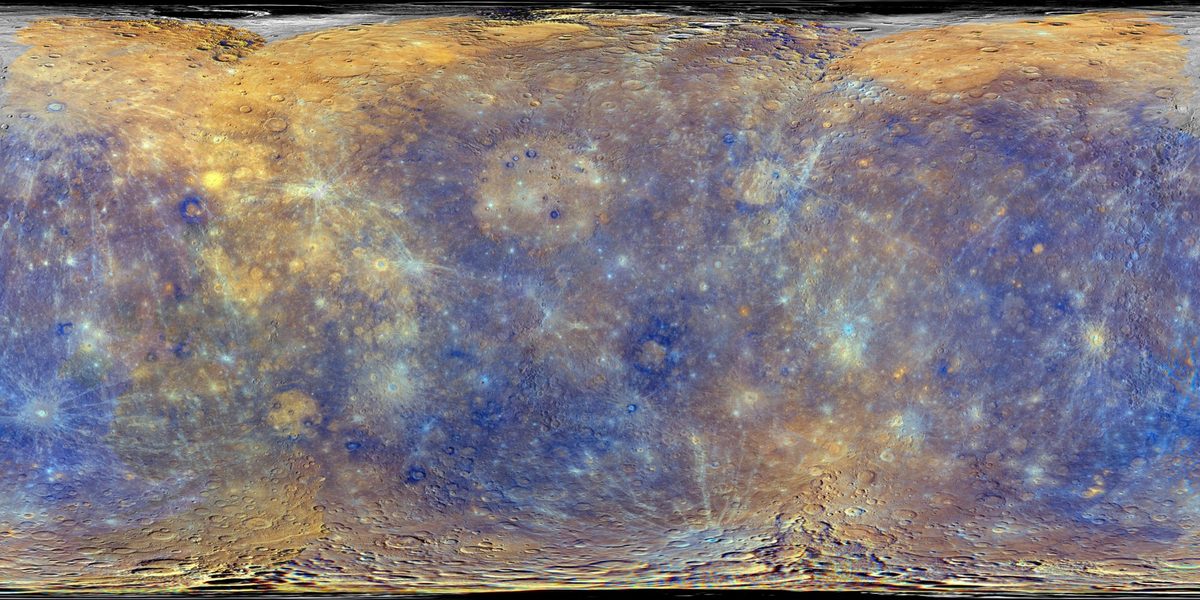
After an epic eight-year journey, the European and Japanese BepiColombo spacecraft has arrived at Mercury. On Nov. 21, the European Space Agency announced that a European-built module had inserted itself into orbit around the innermost planet of the solar system, beginning a months-long series of maneuvers. It is only the second mission — after NASA's MESSENGER in 2011–2015 — to enter orbit around Mercury.
The arrival ends one of the longest cruises in spaceflight history. BepiColombo launched on Oct. 20, 2018, from Kourou, French Guiana, and needed to gradually lower itself closer to the Sun without gaining speed and overshooting Mercury. The journey included a nearly year-long delay caused by an electrical issue affecting the spacecraft's ion thrusters, as well as multiple flybys of Earth, Venus and Mercury to shed energy. A series of thruster firings slowed the spacecraft enough to be captured by the planet's weak gravity, and it took several anxious hours before flight controllers in Germany could confirm that BepiColombo had achieved orbit.
For the time being, the two scientific probes remain joined together. The ESA-built Mercury Planetary Orbiter, known as the MPO, and the Japan Aerospace Exploration Agency's Mercury Magnetospheric Orbiter, known as Mio, will separate in an event planned for Dec. 9–10, allowing each to follow its own orbit at a different altitude. The combined spacecraft must first lower its orbit from an initial 590 by 11,640 kilometers, with five burns executed at precise times. Mio will then trace ellipses at altitudes between 500 and 11,000 kilometers, sampling the planet's magnetic field and how it interacts with the solar wind. The MPO will gradually descend until March 2027, when it will reach its orbit at between 400 and 1,500 kilometers, from which its instruments will continuously study the planet's surface.
Flying together, the pair can measure the magnetosphere from within and without at once, something a single spacecraft cannot do. The MPO, set to orbit as close as 480 kilometers from Mercury's surface, is surface-facing, carrying cameras, spectrometers, an altimeter and a radio science experiment. Mio spins at about 15 revolutions per minute and swings out to roughly 11,000 kilometers to study Mercury's magnetic environment. Mio has 15-meter wire antennas and 5-meter magnetometer booms that must be extended over about a month, and the commissioning phase will continue through March. BepiColombo's science phase will finally begin on April 6, 2027, more than eight years after launch.
The mission is designed to answer some of the solar system's oldest questions. Mercury, though not that much larger than the Moon, is more massive than would be expected for a body of its size, and the leading theory is that it was hit by something very large in the distant past and its outer mantle was removed. Mercury also has a global magnetic field, making it the only rocky planet besides Earth to have one, and the MPO's radio link, accelerometer, laser altimeter and magnetometer will all help probe the interior and how it generates that field. The spacecraft will also map impact craters, volcanic plains, mountain ridges and peaks jutting as high as 3 miles, and study the water ice believed to sit in permanently shadowed craters near both poles.
En route to Mercury, the craft was already able to test some of its onboard instruments. Mission scientists pointed the onboard X-ray camera, the Mercury Imaging X-ray Spectrometer, known as MIXS, at the Crab Nebula, the remnants of a supernova witnessed on Earth in 1054. MIXS is the first X-ray imaging device to be sent on an interplanetary mission, according to Emma Bunce, a plasma physicist at the University of Leicester and one of BepiColombo's leading mission scientists. The MPO could also image the resting site of MESSENGER, which struck Mercury at about 3.9 kilometers per second when its mission ended in 2015, leaving a crater estimated at about 16 meters wide.
Getting there was only the first hurdle. Given the orbiters' proximity to the Sun, thermal protection is crucial: solar radiation can be 10 times what is received at Earth, and temperatures are extreme. Each separation event — including one in which the spacecraft dumped its Mercury Transfer Module in early September — leaves holes in the coverings that must close. "If they don't close, then we will have a serious problem," said Ignacio Tanco from ESA's Inner Solar System Missions Unit. "The impact could potentially be severe," depending on the failure mode. Mission manager Santa Martinez noted that contingency procedures have been rehearsed for various cases during the separations. Travelling to the solar system's innermost regions is a "prolonged affair," Bunce said. "Energetically, it takes more energy to go to Mercury than to go to the outer Solar System."
The European Space Agency has invited journalists to a briefing on the mission's arrival on Nov. 27, at the Science Museum in London and online, where experts from ESA, JAXA and Airbus will update the public on the status of the mission and the road ahead. ESA has not said how quickly new images will reach the public; lead project scientist Geraint Jones said the question would go to a science team meeting in Lisbon this month. For now, the two orbiters are circling the smallest planet in the solar system together, eight years after they left Earth, with their real work still months away.
Why it matters: BepiColombo's arrival matters because Mercury is the least understood of the rocky planets, and the only one besides Earth with a global magnetic field — a clue to how planets build and keep their interiors. Two orbiters working at once, one close to the surface and one far out in the magnetic field, will give scientists the first simultaneous inside-and-outside view of a planet that has resisted easy explanation since Mariner 10 first flew past it half a century ago. The science does not begin until April 2027, but the hard part — an eight-year journey, a damaged thruster system and a capture burn far from home — is now behind it.
Reporting: Nature · Sky & Telescope
Spot an error? Orbit News corrects articles promptly and notes the correction in the article. See our Editorial Policy, or flag an error by messaging us on Facebook, X, or Instagram.
Related from Orbit News
Mexico Captures FBI Most-Wanted Cartel Boss 'El Chapo Isidro' as Gunfight Leaves 11 Dead
World · Nov 22, 2026
At Least 24 Dead as Boat Carrying Mourners to a Funeral Capsizes in Southern Nigeria
World · Nov 22, 2026